By: Kiaran Locy, California Prune Board – Sacramento
Returning from the holiday break and into a new year, Class 55 arrived in Chico with three seminars behind us and an entire year of learning still ahead. On paper, it felt like a moment to pick up speed. In practice, Chico asked us to slow down.
The focus of the seminar, “community,” may sound simple. Most of us value it, rely on it, and speak about it often. Yet Chico made clear that community is also where leadership becomes most demanding: where difference surfaces, tension lingers, clarity is incomplete, and the instincts that have served us well can begin to work against connection. That tension became the heart of our time together.
Seeing What’s Possible: Learning From Class 54
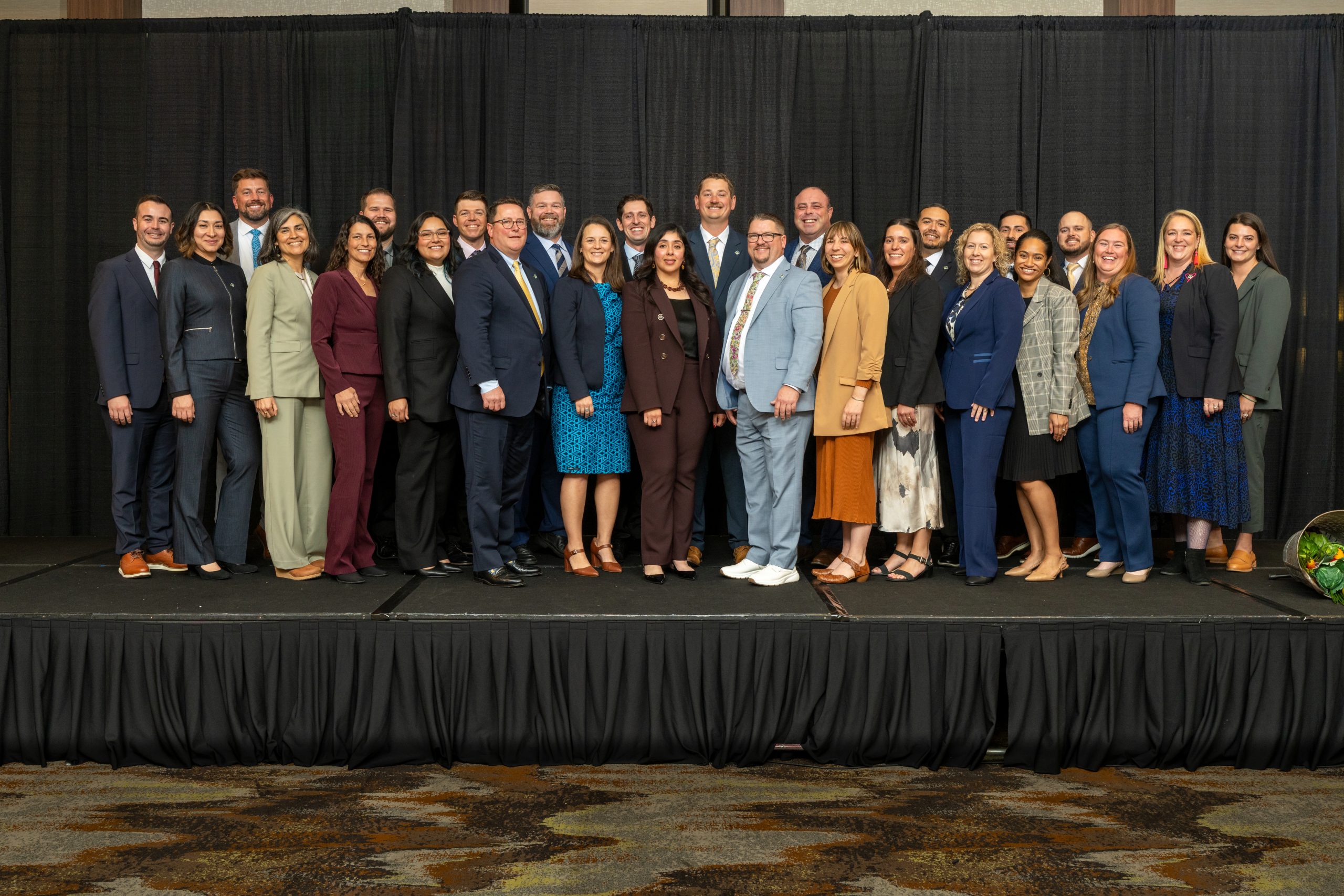
We were welcomed to Chico by our “big siblings” in Class 54, who generously shared their experiences as they approach commencement. Watching how comfortable they were with one another and the Education Team members—how easily they spoke honestly, loosened up, and showed up fully—offered a glimpse of what sustained community can look like over time.
As we broke into small groups and listened to Class 54 reflect on their California Ag Leadership journey via their Impact Portfolio practice, we saw both process and outcome. Twists, uncertainty, recalibration, and discovery were woven throughout their stories. It was a reminder that leadership clarity is not something you arrive with, but something that emerges through relationships, experience, and time.
When the Urge to Solve Shows Up
That reminder became personal sooner than I expected. While preparing for a class meeting with a few fellows, we discussed overlapping committee efforts and how they might be shared with the broader class. As the conversation unfolded, I felt a familiar urge rise in me: the desire to define a clearer, more uniform process for everyone.
At first, it felt responsible and efficient. But as I sat with my own agitation, it became clear the urgency wasn’t coming from the group, it was coming from me. I wanted clarity because I wanted to know what to offer and how to do so. I had recently learned about different learning styles—the need for the why, what, how, and what-if—and noticed myself expecting every process to immediately account for all of it. That moment required me to pause instead of solve, and to trust that not every ambiguity needed to be resolved by me. It was an early signal of what Chico was asking us to practice.
Bridging Across Difference: From Classroom to Community
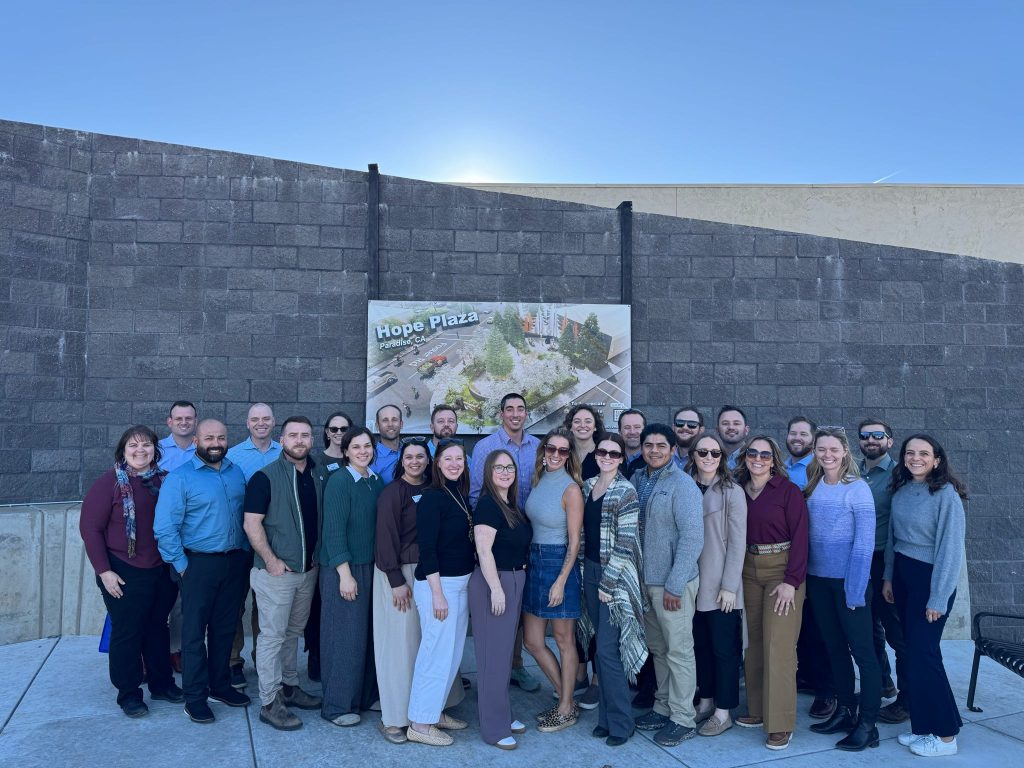
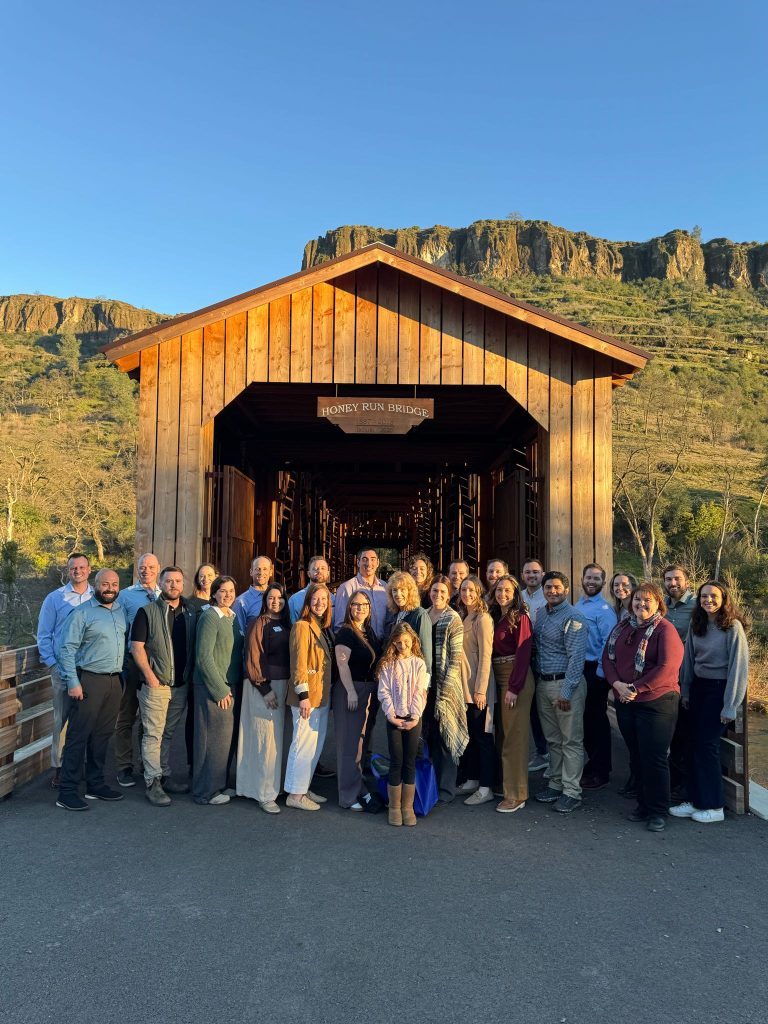
Prior to our field tour, Dr. DeAtley (Class 52) exposed us to the concept of community, defined as a group of people connected by shared identity, place, purpose, or values. Dr. DeAtley emphasized that members of strong communities have improved mental and physical health, higher life satisfaction, and recover faster after crises. That insight moved quickly from theory into practice as we toured the town of Paradise and the Honey Run Covered Bridge.
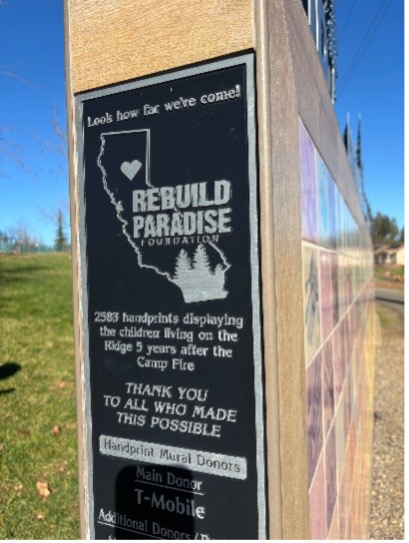
In Paradise, we encountered a community rebuilding after total devastation from wildfire seven years ago. While the loss was shared, the realities shaping the rebuilding process were not. Urgency, grief, regulation, timelines, and trust all informed different perspectives. There was no singular solution, only layered truths. At the Honey Run Bridge, we saw a different form of complexity through the work of the Association: shared infrastructure layered with history, regulation, environmental concerns, and competing interests. Progress here, too, depended less on agreement and more on sustained relationships.
These places became living examples of spectral thinking. Our role was not to solve, but to listen, to ask thoughtful questions, notice tradeoffs, and stay present without offering fixes. It was uncomfortable and deeply instructive.
Belonging Shapes Who Can Learn
Back in the classroom, we explored belonging as a foundation for leadership and learning. We examined zones of belonging, from marginal participation to conditional belonging to full belonging, and how proximity to the center determines whether it feels safe to speak, learn, and adapt.
One insight stayed with me: conflict is not a failure of community; it is often evidence that people care.
For those of us closer to the center of belonging, leadership carries added responsibility. Efficiency, while often rewarded, can unintentionally narrow who feels invited to participate in conversations. Perhaps in the end we lose out on the best possible solutions as a result. Pausing can feel risky, but it can also create space for shared ownership and as leaders, we maximize our impact by doing this very thing.
Reframing a Leadership Moment
The week before Chico, I spent two days with our Board’s Executive Committee discussing the forces shaping our industry and clarifying what is within our control. Sitting with pages of notes afterward, I felt the familiar pull to define next steps quickly.
Chico helped me realize that what I was really wrestling with wasn’t just what comes next, but who gets to help shape it. I find myself sitting with new questions: Who is part of this next phase? What follows a staff discussion so we can truly roll up our sleeves together? How do we invite participation without forcing alignment too quickly? Can I create space for people who I know have a different perspective and help them feel like they can contribute to the conversation and overall goal?
Before Chico, I would have rushed to answer those questions. Now, I am practicing patience, considering how belonging and shared ownership are built, not assumed.
Carrying It Forward
Community does not change by accident. It reflects our daily leadership choices, both action and restraint. Ag Leadership provides a rare space to practice this work honestly and carry it back into the communities we shape: our families, workplaces, neighborhoods, and industries. It really is the sandbox our Director of Education speaks of.
As Class 55 moves forward, I feel both excitement and uncertainty. What feels certain is that we are already building something together. If we can continue to resist the urge to solve too quickly and stay connected through discomfort, we will be better equipped to lead whatever comes next.
Leadership, I am learning, is less about having the answer and more about staying present long enough for understanding to emerge.
See how leadership lessons are sitting with other fellows in Class 55:
Class 55 would like to extend gratitude to:
Our Education Team for shepherding our time, attention and learning.
Class 54 for their mentorship and guidance.
Dr. David Hassenzahl for welcoming us to CSU Chico and Dr. Kasey DeAtley (Class 52) for taking a risk and trying on a new lesson with us.
Dr. Alyssa Schager and Ms. Nikol Baker of Glenn County Office of Education for giving us a diagnostic tool we can use in a variety of ways.
Rebuild Paradise Foundation and the Honey Run Covered Bridge Association for taking the time out of their day to share their experiences and learnings on how a real community rebuilds and strengthens.